JW Marriott Hotel Bogota
When you book JW Marriott Hotel Bogota in Colombia through our Marriott Luminous partnership, your stay includes daily breakfast for two and a welcome amenity. You also receive a room upgrade, early check-in and late check-out when available. No premium credit card or membership needed: request a quote and our advisor books it at the same rate as booking direct.
Exclusive Booking Perks
These perks are included with your stay at the same rate as booking direct with the hotel.
- Welcome amenity
- Complimentary breakfast daily for two guests per room
- Early check-in and late check-out (when available)
- Complimentary upgrade (if available at check-in)
Location
Bogotá rises from the Andean altiplano at 2,582 metres, a sprawling metropolis where the thin mountain air sharpens every sensation. The city's colonial heart, founded in 1538 by Spanish conquistador Gonzalo Jiménez de Quesada on the lands of the Muisca people, pulses with the weight of five centuries: it served as the seat of the Viceroyalty of New Granada and became the capital of Gran Colombia after Simón Bolívar's triumph at the Battle of Boyacá in 1819. Today, Bogotá is Colombia's political, cultural, and economic engine, a city of eight million where glass towers share the skyline with terracotta-roofed colonial buildings and where the scent of fresh arepas mingles with diesel exhaust on perpetually busy streets.
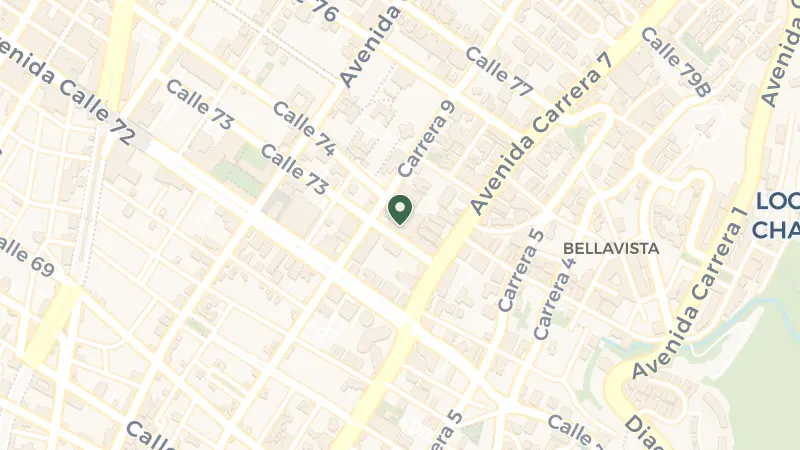
The property sits in Chapinero, a district that climbs the eastern slopes of the cordillera, where the urban grid gives way to forested ridges and the air grows cooler as elevation rises. This is a neighbourhood of contrasts: modernist office blocks stand alongside converted republican mansions, and the hum of commerce quiets as you move uphill toward the city's green lung.
El Dorado International Airport lies eleven kilometres west, accessible via highways that cut through the sabana, the high plain that cradles the city against the mountains.
The property's location in Chapinero places you within reach of Bogotá's cultural and natural range. To the east, the Andean foothills offer escapes from the urban sprawl: Cascada Las Delicias tumbles through cloud forest just two and a half kilometres away, while the more dramatic La Chorrera, Colombia's highest waterfall, drops 590 metres through mossy gorges twelve kilometres into the mountains. The city's golf culture thrives at altitude; Campo de Golf Público, three kilometres north, offers public access to high-elevation play where the ball carries farther in the thin air.
Bogotá's dining scene concentrates in neighbourhoods like Usaquén and La Macarena, where chef-driven restaurants champion Colombian ingredients with techniques borrowed from Europe and Asia. The city's markets remain essential: explore the stalls for uchuvas, lulo, and guanábana, fruits that define the Andean palate. Book a table at one of the capital's inventive new Colombian kitchens and order ajiaco, the chicken and potato soup that Bogotanos claim as their own, served with capers and cream and a side of avocado so creamy it collapses under a spoon.
Bogotá's eternal spring is a misnomer; the city's equatorial location and altitude create a climate that hovers perpetually in the mid-to-high teens, but the texture of each month shifts with the rains. January through March begins dry and bright, the sabana glowing yellow-green under crystalline skies, though by March the afternoon downpours return with equatorial punctuality.
April and May bring the heaviest rains, when the cordillera disappears behind grey veils and the city's brick takes on a darker, slick sheen. June through September offers the driest, clearest months: this is when the mountains reveal themselves fully at dawn, their silhouettes sharp against pale blue, and when the jacarandas erupt in purple along the northern avenues.
October and November return to wet-season rhythms, the air cool and close, the streets smelling of wet stone and eucalyptus. December dries out again as the city strings lights for the season, though morning fog lingers in the higher barrios until midday sun burns it off.
Frequently Asked Questions

Quotes are personally reviewed by Natasha Hardy, founder of The Uncommon Traveller
5.0 rating · 8 Google reviewsThere is no fee or markup. The hotel pays our commission.
Request a Quote