Sofitel Wellington
Wellington New Zealand Oceania
Guest rating 9.0/10 (774 reviews)When you book Sofitel Wellington in New Zealand through our Accor Hera partnership, your stay includes daily breakfast for two and a $100 USD hotel credit. You also receive a room upgrade, early check-in and late check-out when available. You continue earning ALL Accor points and elite night credits. No premium credit card or membership needed: request a quote and our advisor books it at the same rate as booking direct.
Exclusive Booking Perks
These perks are included with your stay at the same rate as booking direct with the hotel.
- Daily complimentary breakfast for 2, per room
- $100 USD credit to be spent on property (conditions defined at check-in)
- Early check-in & late check-out (upon availability)
- Upgrade at time of check-in (upon availability)
Guest feedback
9.0/10 from 774 guest reviews
By category
Guests liked
- Friendly staff
- Great location
- Comfortable rooms
Points to consider
- Maintenance issues
- Limited breakfast service
- Cold food at breakfast
Location
Sofitel brings Parisian polish to the world's southernmost capital, a pairing that suits Wellington's own cosmopolitan confidence. This is a city that understands both refinement and resilience, its cultural institutions and waterfront promenades shaped by the constant push of wind off Cook Strait. The brand's philosophy of blending French elegance with local character finds natural expression here, where Te Āti Awa heritage and colonial history layer beneath a compact, design-conscious downtown.
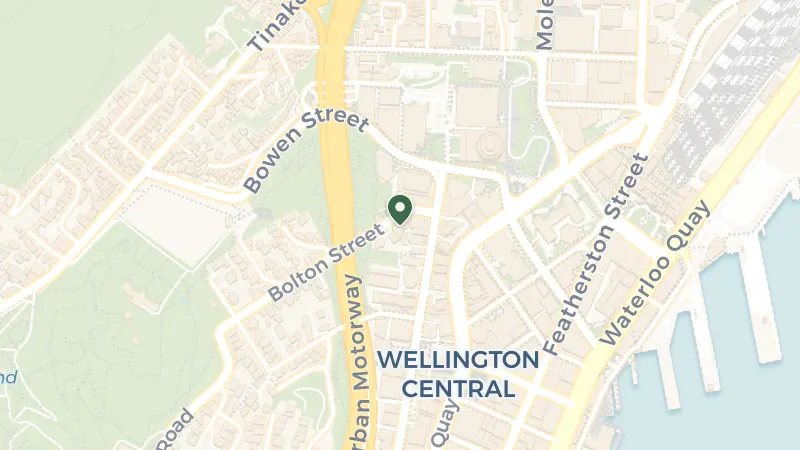
The property sits in Lambton, within Wellington Central's financial heart, where high-rise towers climb the lower slopes and grid streets stretch toward the harbour. Walk five minutes and you're at the waterfront, ten and you've reached Civic Square with City Gallery Wellington's contemporary exhibitions. St Mary's Cathedral, a neo-Gothic landmark from 1851, stands nearby, its wooden interior a reminder of the city's early colonial ambitions.
This is New Zealand's political and cultural capital, but it feels more like a tightly wound cultural laboratory than a governmental seat. The city was laid out in 1840 by Captain William Mein Smith for Edward Wakefield's New Zealand Company, a grid imposed on steep terrain with optimism that exceeded topographical sense. Wellington International Airport lies six kilometres south, connected by tunnel-threaded roads that hug the rocky coastline.
The immediate surroundings reward exploration on foot: Stellin Memorial Park sits 800 metres away, while the Harbourside Market, a kilometre and a half east along the waterfront, brings weekend crowds for artisan produce and prepared foods. For serious dining, three Michelin-starred restaurants cluster within two kilometres. Jano Bistro, 1.7 kilometres south in a historic cottage, weaves herbs and edible flowers from its own garden into French contemporary dishes. Logan Brown occupies the domed 1920s National Bank building at the same distance, Corinthian columns framing contemporary New Zealand cooking. Ortega, 1.8 kilometres away, leans into its maritime setting with blue walls and glass floats, the menu shifting with daily catch prepared in styles spanning European to Latin American techniques. Book a table at Logan Brown for the full theatrical effect of that banking hall turned dining room.
Beyond restaurants, the waterfront stretches in both directions: Chaffers Marina lies 1.3 kilometres southeast, Oriental Beach two kilometres out for sand underfoot and harbour views. Te Aro Wine, a compact urban winery 1.7 kilometres distant, pours local vintages. Further afield, Ōtari-Wilton's Bush (2.2 kilometres) preserves native forest within city limits, while Freyberg Beach and Oriental Beach offer windswept coastline easily reached on foot or by short bus ride.
Summer, December through February, brings the warmest days, temperatures hovering between 18 and 19 degrees with occasional spikes that send Wellingtonians to Oriental Beach. The light turns sharp and clear, though the wind never fully retreats. This is peak season for festivals and outdoor performances, the waterfront alive with foot traffic.
Autumn cools gradually, March through May seeing temperatures drop from 18 to 14 degrees as leaves turn on the city's hillside reserves. The wind softens slightly, and golden light slants low across Cook Strait in the late afternoons. Winter, June through August, settles in the low teens with grey skies and persistent rain, the city taking on a moody, introspective character.
Spring arrives fitfully, September through November warming from 12 to 15 degrees. The wind picks up again, justifying the city's reputation as the world's windiest capital, but the light lengthens and the harbour glitters between squalls. Late spring offers the best balance: mild days, fewer crowds, and Wellington's cultural calendar accelerating toward summer.
Frequently Asked Questions

Quotes are personally reviewed by Natasha Hardy, founder of The Uncommon Traveller
5.0 rating · 8 Google reviewsThere is no fee or markup. The hotel pays our commission.
Request a Quote 4 Bib Gourmand