Velaa Private Island
When you book Velaa Private Island in Noonu Atoll, Maldives, through our Virtuoso partnership, your stay includes daily full breakfast for up to two guests. You also receive a room upgrade, early check-in and late check-out when available. No premium credit card or membership needed: request a quote and our advisor books it at the same rate as booking direct.
Exclusive Booking Perks
These perks are included with your stay at the same rate as booking direct with the hotel.
- Upgrade on arrival, subject to availability
- Daily Full breakfast for up to two guests per bedroom, served in the restaurant
- $150 USD Food & Beverage credit to be utilized during stay in any of the resort's restaurants, bars or for room service. (not combinable, no cash value if not redeemed in full)
- Early Check-In / Late Check-Out, subject to availability
Location
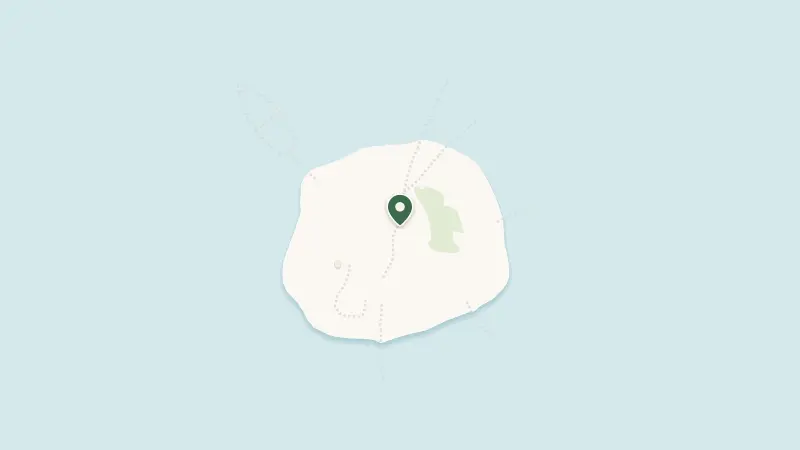
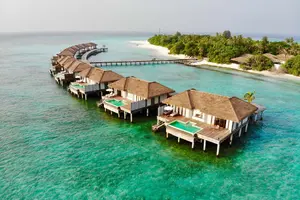
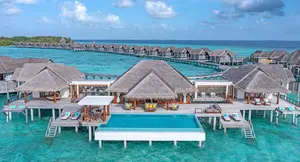
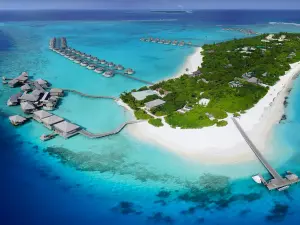
Velaa Private Island occupies its own coral atoll in the northern Maldives, where the Indian Ocean stretches unbroken in every direction and the nearest inhabited land feels worlds away. This is the Noonu Atoll, a remote constellation of islands where the ratio of reef fish to people tips decisively toward the former. The capital, Manadhoo, lies out of sight across the water, home to the atoll's twelve thousand residents who live largely on fishing and coconut cultivation. Here, the rhythm is tidal rather than urban, the soundscape composed of wavelets against sand and the occasional thrum of a dhoni motor.
The resort exists as its own self-contained universe, a single private island where everything unfolds on the property itself. The surrounding waters hold sandbanks that emerge and vanish with the tide, including Vihafarufinolhu, eighteen kilometres north, a ribbon of white sand that appears for a few hours each day like a mirage. The atoll's reefs drop steeply into deep channels where manta rays glide and whale sharks pass through on seasonal migrations.
Velaa is reached by seaplane from Velana International Airport on the main atoll, a forty-five-minute flight that transforms the journey into spectacle, the turquoise lagoons and coral atolls unrolling below like stained glass. Maafaru International Airport, twenty-nine kilometres away, offers an alternative via speedboat for those arriving on domestic or regional flights.
The property's dining unfolds across multiple venues, each with its own temperament, though none carry Michelin stars. The Indian Ocean provides the daily catch, and meals lean into that abundance: grilled reef fish, octopus curry fragrant with Maldivian spices, and tuna prepared in the island style. The kitchen takes cues from both the surrounding waters and the broader arc of Asian coastal cooking, with a wine programme that runs deep. Book a table for sunset and watch the light turn the lagoon molten.
Beyond the shoreline, the real attraction is the reef itself. The house reef drops precipitously, accessible directly from the island's perimeter, where you can swim among napoleonfish and hawksbill turtles without a boat transfer. Dive excursions venture to outer atolls where currents bring larger pelagics. For those drawn to stillness rather than motion, the sandbanks offer near-total isolation, reachable by dhoni and entirely empty save for the occasional reef heron. Don't miss a night dive when conditions allow: the reef transforms under torchlight, and bioluminescent plankton trace blue-green trails in the water.
The Maldives hold steady near the equator, where air and sea temperatures barely shift across the year. Daytime highs hover in the high twenties, the water perpetually warm enough to slip into without hesitation. The light has an equatorial intensity, white and unfiltered, that makes colours almost unnaturally vivid against the reef.
The northeast monsoon from December through March brings the driest skies and calmest seas, ideal for diving when visibility stretches thirty metres or more. April and May turn hotter and still, the air thick before the southwest monsoon arrives in June. The monsoon months through November see afternoon squalls and rougher water, though rain tends to pass quickly and the reef life pulses with plankton blooms that draw mantas inshore.
The shoulder months of April and November offer a middle ground: fewer travellers, softer light, and seas calm enough for most water activities. Whale shark sightings peak from May through November when plankton concentrations rise, a compelling reason to embrace the rainier season.
Frequently Asked Questions

Quotes are personally reviewed by Natasha Hardy, founder of The Uncommon Traveller
5.0 rating · 8 Google reviewsThere is no fee or markup. The hotel pays our commission.
Request a Quote