Amanjena
When you book Amanjena in Marrakech, Morocco, through our Virtuoso partnership, your stay includes daily breakfast for up to two guests and a $100 USD food and beverage credit. You also receive early check-in and late check-out when available. No premium credit card or membership needed: request a quote and our advisor books it at the same rate as booking direct.
Exclusive Booking Perks
These perks are included with your stay at the same rate as booking direct with the hotel.
- Upgrade on arrival, subject to availability (Upgrade to next room level within same room category. i.e Pavilion to Pavilion, Maison to Maison- excludes Al Hamra Maison)
- Daily breakfast for up to two guests per bedroom, served in the restaurant (already included in property rates)
- $100 USD equivalent Food & Beverage credit to be utilized during stay (not combinable, not valid on room rate, no cash value if not redeemed in full)
- Early Check-In / Late Check-Out, subject to availability
Guest feedback
9.8/10 from 79 guest reviews
By category
Guests liked
- Peaceful environment
- Beautiful location
Points to consider
- Bedsheets quality
Location
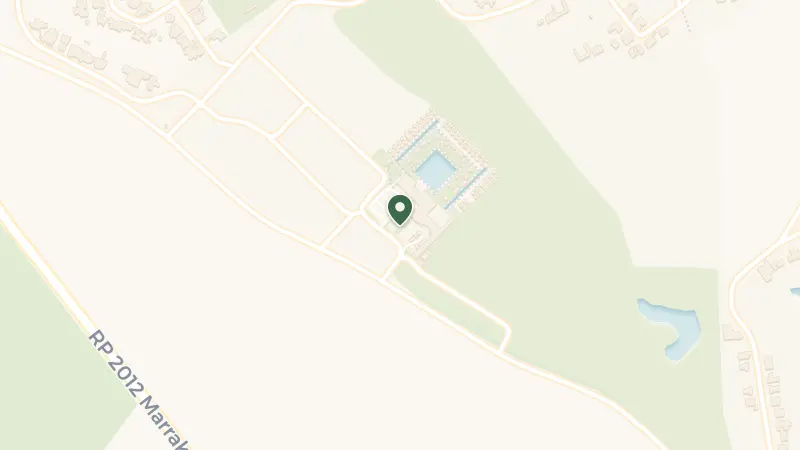
Aman resorts occupy places where history and landscape command attention, and few properties honour that principle as thoroughly as Amanjena. The brand's signature restraint, generous staff ratios, and unhurried rhythms find expression here in a setting that draws on centuries of Moroccan architectural tradition. Marrakech itself is a city of contrasts: the fourth-largest in Morocco, an imperial capital founded by the Almoravids around 1070, and a crossroads that has shaped the western Muslim world for nearly a millennium. The red sandstone walls built by Ali ibn Yusuf in the twelfth century gave the city its enduring nickname, and the fortified medina remains a labyrinth of souks, riads, and Saadian monuments commissioned by sultans Abdallah al-Ghalib and Ahmad al-Mansur.
The property sits in the Arrondissement d'Annakhil, a quieter enclave beyond the medina's bustle, where the foothills of the Atlas Mountains rise to the south and the city's ochre glow softens in the late afternoon light. The scent of orange blossom drifts over garden walls; the call to prayer echoes from distant minarets.
Marrakech Menara Airport lies ten kilometres away, a short transfer that shifts abruptly from the controlled energy of the medina to the stillness of palm groves and private estates.
The medina, a UNESCO World Heritage site six kilometres north, demands at least a full day: navigate the souks of Souika Boussekri and Miâara, where vendors sell everything from hand-stitched slippers to saffron by the gram, then lose yourself in the tanneries and jewellery stalls of Bijouterie Ouadia and Souq El Kessabine. The Saadian tombs, rediscovered in 1917, and the twelfth-century Koutoubia Mosque anchor the medina's southern edge. Book a private guide to decode the geometry of Ben Youssef Madrasa, its stucco work a masterclass in Marinid craftsmanship. Further afield, the Ksar of Ait-Ben-Haddou, ninety-nine kilometres southeast, rises like a fortress from the pre-Saharan plain, its earthen towers and defensive walls a testament to traditional Berber architecture.
Golfers have a choice of championship courses within ten kilometres: Marrakech Golf City, The Montgomerie, and Atlas Golf all offer views of the Atlas peaks. The Rmila reserve, thirteen kilometres out, is less trafficked but worth the detour for birdwatching in the dry season. Start your mornings early, when the light is clearest and the medina stirs to life before the midday heat.
Summer arrives with force: July and August push the thermometer past 36°C, and the city empties in favour of coastal escapes. The light is blinding, the air dry, the streets almost silent by noon. Spring and autumn are ideal: March through May and September through November bring daytime highs in the low twenties to low thirties, cool evenings, and enough warmth to sit outdoors after dark without a shawl.
Winter surprises visitors accustomed to Morocco's reputation for heat. January mornings can dip below four degrees, and the Atlas foothills occasionally dust with snow. The sky is sharp and blue, the medina alive with smoke from charcoal grills, the air scented with cumin and wet stone.
Visit between late March and early June, or in October, when the weather balances warmth with clarity and the city feels neither crowded nor shuttered.
Frequently Asked Questions

Quotes are personally reviewed by Natasha Hardy, founder of The Uncommon Traveller
5.0 rating · 8 Google reviewsThere is no fee or markup. The hotel pays our commission.
Request a Quote