Park Hyatt Jakarta
When you book Park Hyatt Jakarta in Indonesia through our Hyatt Privé partnership, your stay includes daily full breakfast for up to two guests and a property credit. You also receive a priority room upgrade, early check-in and late check-out when available. You continue earning World of Hyatt points and elite night credits. No premium credit card or membership needed: request a quote and our advisor books it at the same rate as booking direct.
Exclusive Booking Perks
These perks are included with your stay at the same rate as booking direct with the hotel.
- Welcome amenity provided to guests upon arrival.
- Daily complimentary full breakfast at a hotel restaurant for up to two guests.
- Property credit (value varies by property).
- Priority for room upgrade (response within 24 hours of booking, subject to forecasted occupancy).
- Early check-in/late check-out/connecting rooms (response within 24 hours of request, subject to forecasted occupancy).
Guest feedback
9.6/10 from 345 guest reviews
Read what guests commentedBy category
Guests liked
- Helpful staff
- Pleasant facilities
Points to consider
- Noisy corner suite
- Cleanliness issues
Location
Park Hyatt properties occupy a distinct register within the luxury landscape: intimate rather than palatial, residential rather than theatrical, art-forward rather than status-driven. The brand invests in curated collections, destination dining by noted chefs, and service that reads as personal connection, not scripted choreography. In Jakarta, that philosophy finds expression in a city that has spent centuries absorbing arrivals, collisions, and transformations.
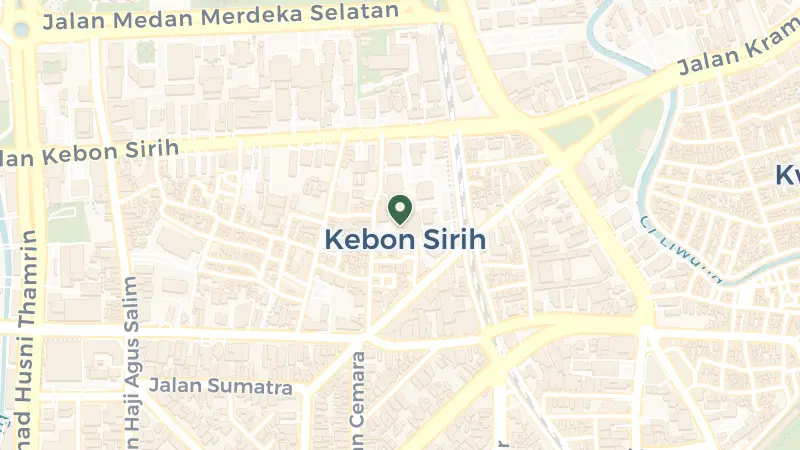
The Kebon Sirih neighbourhood sits within the broader pulse of central Jakarta, a metropolis that sprawls across the northwestern flank of Java and functions as the political, economic, and cultural engine of Indonesia. This is a city that began as Sunda Kelapa, a trading port for the Sunda Kingdom, was seized and rebuilt as Batavia by the Dutch East India Company in 1619, endured Japanese occupation, and emerged as Jakarta upon independence in 1945. The layering is visible: colonial facades alongside glass towers, street markets threading through business districts, the Java Sea salting the air to the north.
The property anchors itself in a district where embassy clusters and corporate offices meet residential enclaves. Within walking distance, the cadence shifts quickly: office workers spill into warung stalls at lunch, tailors stitch bespoke shirts in narrow shopfronts, jasmine sellers arrange strings of bunga setaman at dusk. Halim Perdanakusuma International Airport lies eleven kilometres southeast; Soekarno-Hatta, the primary international gateway, sits twenty kilometres west with dedicated toll road access.
Park Hyatt Jakarta channels the brand's reputation for destination dining into its on-property venues, though the property's culinary roster draws equally from the city's broader appetite for experimentation and tradition. The immediate surroundings offer no Michelin-starred dining, but Jakarta's food culture operates on a different axis: night markets, fine-dining experiments with Javanese foundations, and neighbourhood warungs where depth of flavour outweighs tablecloth formality. Book a table at Skye, the rooftop bar that serves Southeast Asian plates alongside craft cocktails, and watch the skyline bleed into the Java Sea haze at sunset.
Beyond the property, Jakarta reveals itself in markets and cultural sites. Pasar Kembang Cikini, less than two kilometres south, trades in flowers and street snacks; vendors bundle orchids beside stalls frying tempe mendoan and pisang goreng. The Muara Angke Wildlife Refuge, twelve kilometres northwest, protects one of the last remaining mangrove forests along Java's coast, a tidal world of mudskippers and migratory shorebirds that offers relief from the city's density. For golf, the Jakarta Golf Club sits five and a half kilometres east, an eighteen-hole course established during the colonial period and still threading between mature rain trees.
Jakarta sits seven degrees south of the equator and holds to a warm, humid rhythm year-round, with temperatures hovering between 28°C and 31°C. The distinction lies not in temperature but in rainfall: the wet season from November through March brings afternoon downpours that drum on zinc roofs and flood low-lying streets, while the dry season from June to September offers clearer skies and lighter air.
May through September marks the most comfortable window for walking the city, when humidity drops slightly and rain becomes rare. Mornings feel sharp, the Java Sea breeze cuts through exhaust haze, and market awnings stay dry. Even during the wet months, rain arrives predictably in late afternoon, leaving mornings clear for exploration.
December and January see the heaviest downpours, but Jakarta's rhythm doesn't pause. Street food vendors shelter under tarps, shopping districts stay dry beneath covered arcades, and the city's museums and galleries offer respite when the sky opens. Come prepared for warmth and occasional deluge, and Jakarta rewards at any season.
Frequently Asked Questions

Quotes are personally reviewed by Natasha Hardy, founder of The Uncommon Traveller
5.0 rating · 8 Google reviewsThere is no fee or markup. The hotel pays our commission.
Request a Quote